
Language Settings
Plan requirement: The portal-level settings on this page — main language, language files and Google Translate — require Pro and above. Choosing the language you personally see is available to every user on every plan. Compare plans.
On an earlier plan? Plan names and inclusions changed when we moved to Free, Creator, Pro, Pro + LMS and Enterprise. If you are on an earlier plan, your subscription continues unchanged and you keep everything it included — so you may still see features this article lists under a higher plan. Nothing has been removed from your account.
Super Admins can customise global settings such as language, translations and right-to-left (RTL) support to align the platform with organisational and regional requirements.
The following can be managed from the Settings section:
Set or Change the Platform Language
As a Super Admin, you can set the main language for your portal or create new custom translations using JSON language files.
Log in to your Coursebox portal as Super Admin.
Go to Settings → Language.
You'll see a list of available languages under Main Language (like English, Français, Español, etc.).
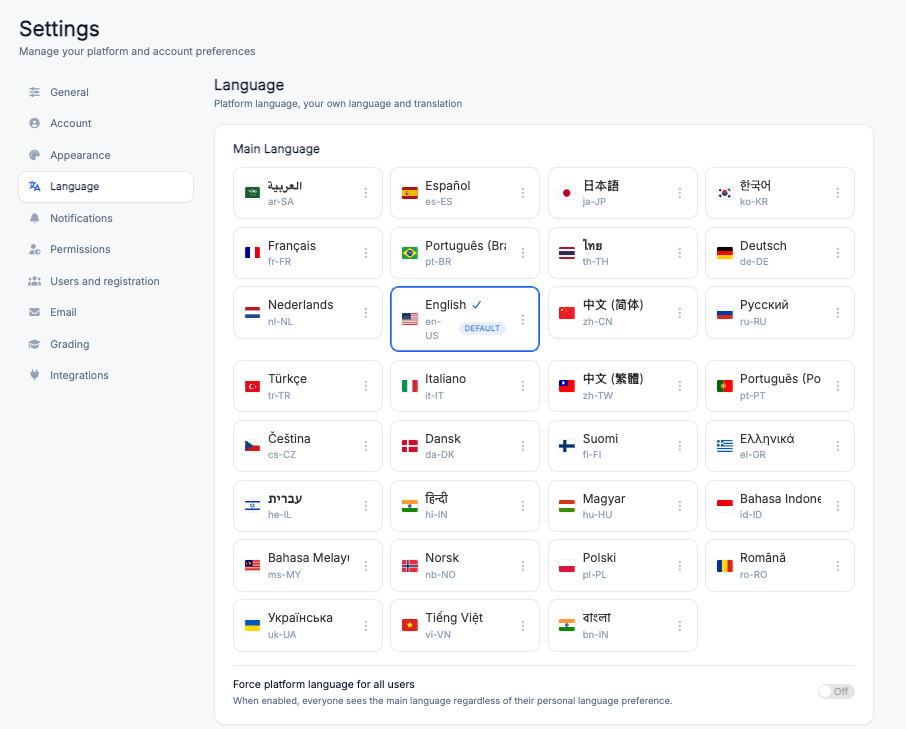
Click the language name you want to make the main language (e.g., English).
The blue checkmark ✓ will show next to your selected default language.
This becomes the default language for your portal and all new courses.
Download and edit a language file (optional)
If you'd like to change the wording that appears throughout your Coursebox portal — for example, renaming "Learning" to "Course" or translating the interface into another language — you can do this by editing the language file.
Click the download icon ⬇️ next to the language you want to edit.
This saves a .json file (language file) to your computer.
Open the file in a code editor such as Visual Studio Code or an online editor like jsoneditoronline.org.
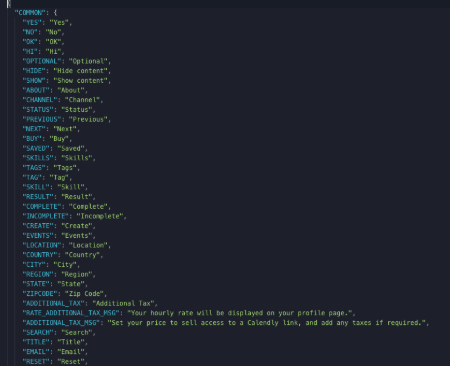
The language file is written in JSON (JavaScript Object Notation) format. This structure uses key–value pairs — the text on the right-hand side of the colon (:) is what appears in your portal and can be safely edited. In a code editor the editable text appears in green; leave the blue text untouched.
For example, to change 'Learning' to 'Course', change only the word Learning in the green text. You can use the same file to translate the interface from English into any other language.
If you're unfamiliar with JSON syntax, it's best to involve someone on your team with basic coding or translation experience. Alternatively, reach out to the Coursebox Support Team for guidance or assistance in applying your changes safely.
RTL for courses in right-to-left languages
Coursebox supports building courses for right‐to‐left languages (e.g., Arabic, Hebrew, Persian, Urdu). Use the options below to set RTL at the course, page, or block level.
Set Your Personal Language
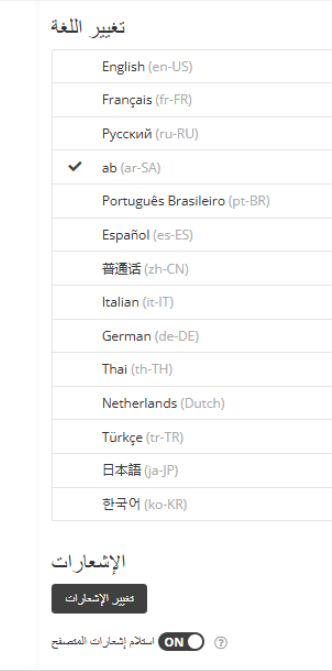
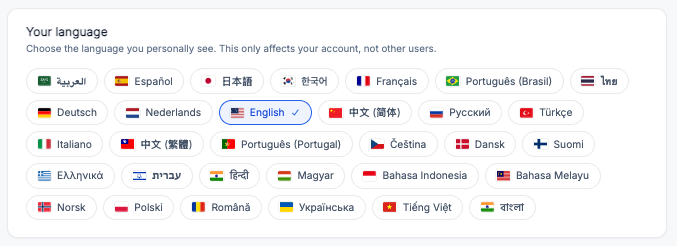
Each user can choose the language they personally see across the platform. This setting only affects your own account and does not change what other users see.
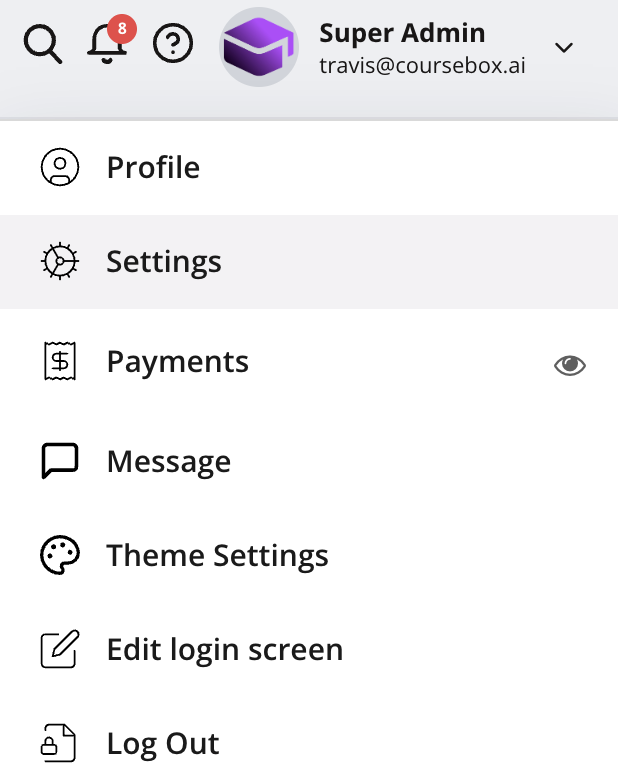
Click your profile icon (top right) and go to Settings.
Under Your language, click the language you'd like to use. A checkmark appears next to your selected language (for example, English).
Your interface updates to the chosen language immediately.
Enable Google Translate
Enable Google Translate on your Coursebox platform to let learners automatically translate content in any course into their preferred language.
Log in to your Coursebox portal as Super Admin.
Click your profile icon (top right) and go to Settings.
Scroll down to the Google Translate section.
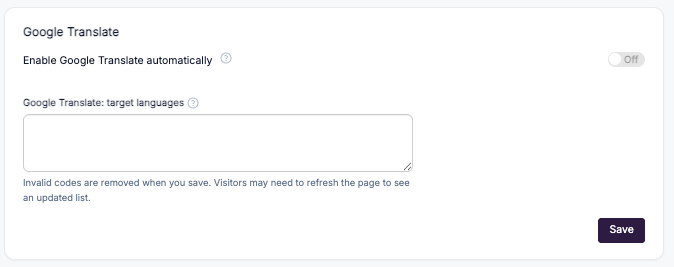
Toggle Enable Google Translate automatically to On to activate it for your users across all courses.
Optionally, toggle Hide floating widget to On to hide the Google Translate floating button from your portal pages.
Optionally, enter specific language codes in the Google Translate: target languages field (comma-separated, e.g. ar, zh-CN, es, fr, de). Leave blank to use Google’s built-in default language list.
Click Save.
Invalid language codes are removed when you save. Visitors may need to refresh the page to see an updated language list.
To add custom HTML to your portal's header bar and footer, go to Settings → Appearance — see Appearance Settings. To set the portal-wide default pass grade and grade labels, see Grading Settings.