
Share & Export a Course
This article explains how to share your Coursebox course and deliver it beyond the platform. It covers sharing a course link, social-media sharing, embedding with an iframe, exporting to PDF/HTML, and integrating with other systems via LTI and SCORM (including self-hosted SCORM, anonymous access, and troubleshooting). To publish a course and set who can access it first, see the companion article Publish a Course.
Plan requirement: Sharing a course link, social sharing and iframe embedding are available on every plan, including Free. Exporting or downloading a course is not included on Free — choosing an export option opens an upgrade prompt instead of a download. Creator and above unlocks PDF, HTML and Dynamic (Standard) SCORM export. Pro and above unlocks Self-Hosted SCORM export, LTI and SCORM import. Compare plans. If you are not ready to upgrade, you can still publish and share your course for free with a Coursebox badge — your course stays exactly as it is.
On an earlier plan? Plan names and inclusions changed when we moved to Free, Creator, Pro, Pro + LMS and Enterprise. If you are on an earlier plan, your subscription continues unchanged and you keep everything it included — so you may still see features this article lists under a higher plan. Nothing has been removed from your account.
Watch the tutorial videos found in our YouTube Video Library.
Share a link to a course
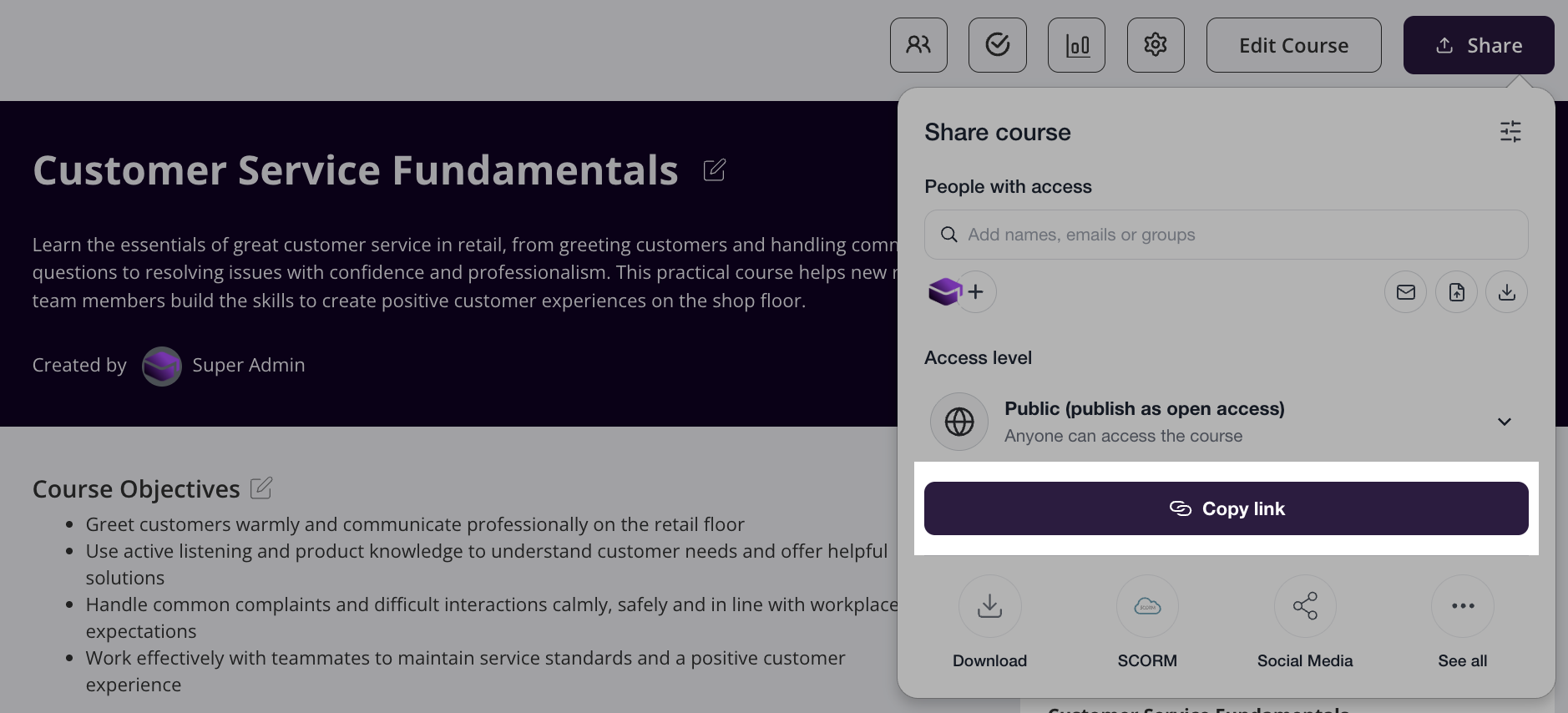
On any course, navigate to the course page and share icon > share the link.
Choosing the right export or integration method
HTML & PDF exports
These are static formats and do not include videos, interactions, or AI-generated visuals. Use these formats only for reference or offline viewing. Available on Creator and above — not included on the Free plan.LTI & SCORM
These are intended for integration with other LMS platforms. Compatibility depends on the target system. They are not recommended for CRMs or website builders. Dynamic SCORM is available on Creator and above; LTI and Self-Hosted SCORM require Pro and above.Embedding on external websites
To preserve videos, interactivity, and design, publish your course and embed it using an iframe. Available on all plans, including Free.CRM integrations (e.g. GoHighLevel)
Use Zapier to automate enrolments. Course content should still be delivered via Coursebox.
Download a course as PDF or HTML
Coursebox gives you multiple export options so you can easily share or host your course outside the platform. Whether you're saving a course for offline use, uploading it to a Learning Management System (LMS), or sharing it as a PDF, Coursebox offers flexible formats to suit your needs.
On any course, click the Share button to open the Share panel, then select Download — the options for PDF or HTML will appear.
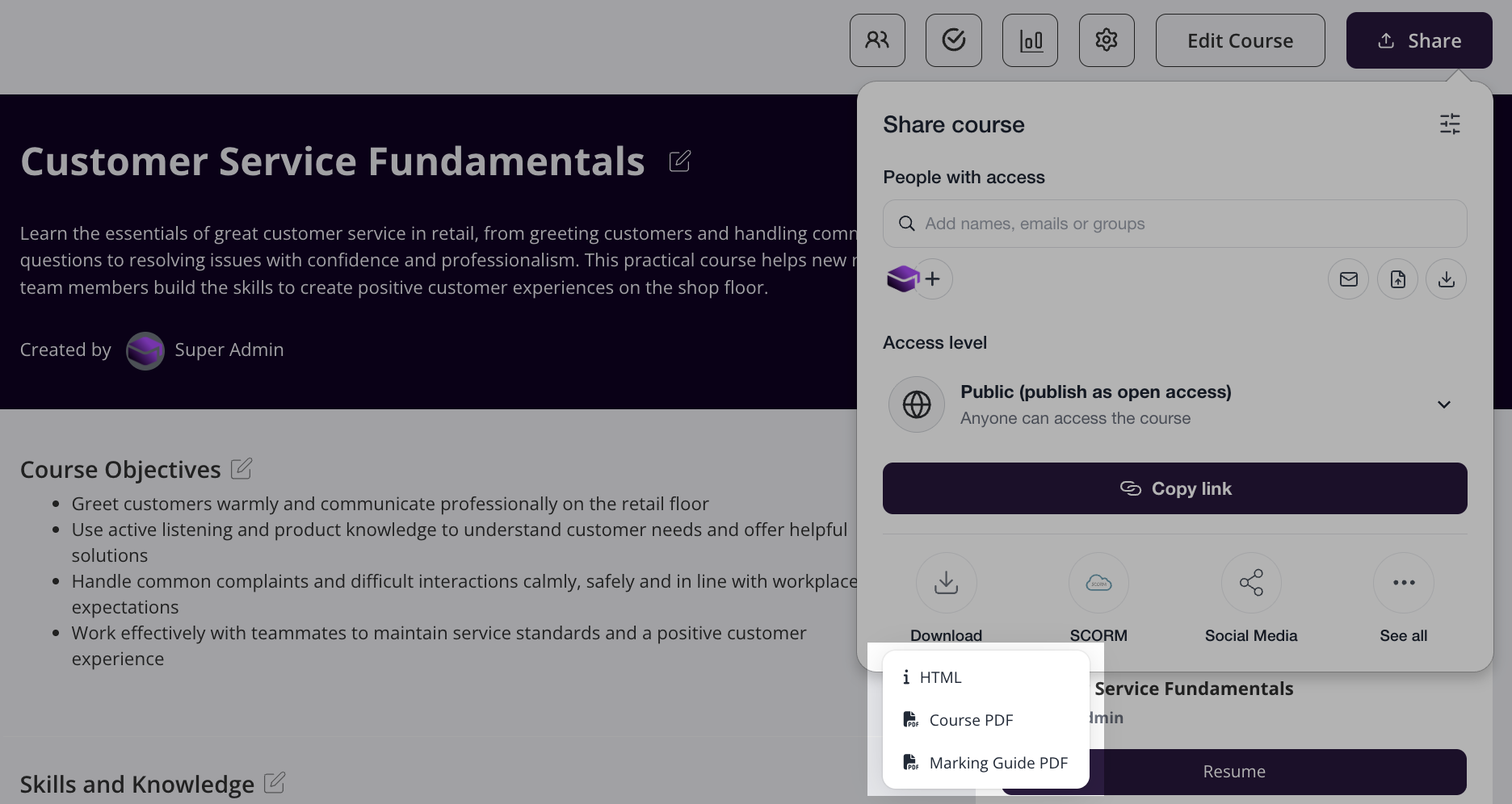
The PDF and HTML backups include the written course structure and content, including learning text, quizzes, assignments, and user-uploaded images. They exclude interactions (eg accordions, SCORM embeds etc), audio recordings, and video recordings. These items may be saved at the course page level in most cases.
PDF and HTML files you have already downloaded are yours to keep — they are static snapshots and continue to work if you later pause or cancel your subscription.
Share a course on social media
Coursebox includes social share buttons in the course Share panel, making it easy to share your published courses directly to social media platforms. This is a great way to promote your courses and drive learner enrolment.
The steps are:
Open your course in the Course Editor.
Click the Share button (top right of the course editor) to open the Share panel. Coursebox does not have a button labelled "Publish" on courses — publishing happens from inside the Share panel.
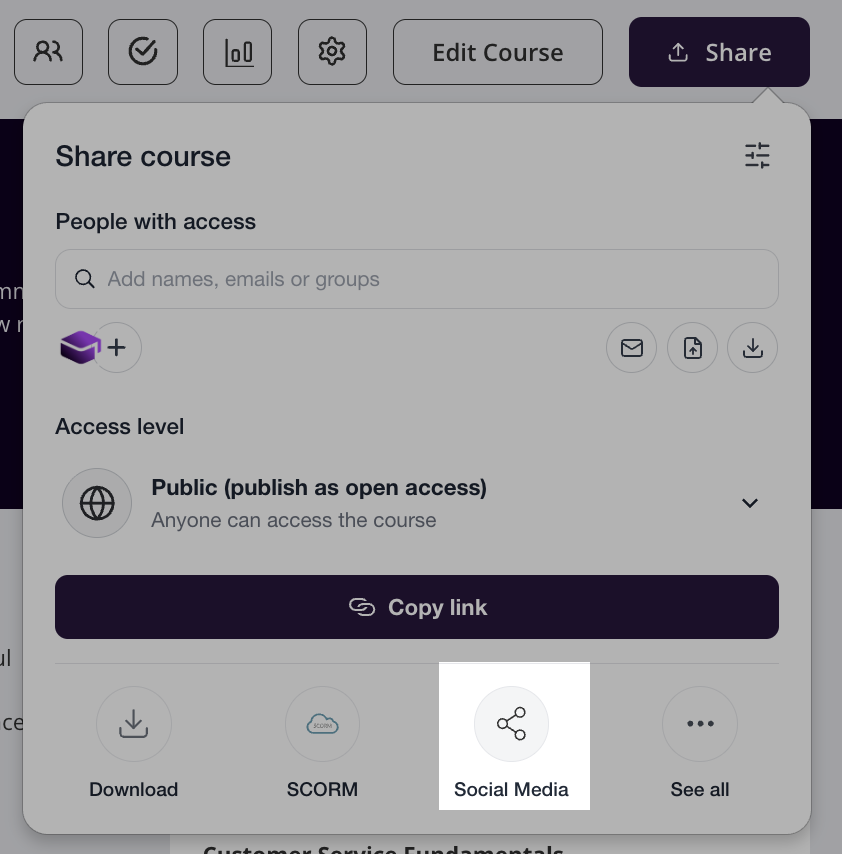
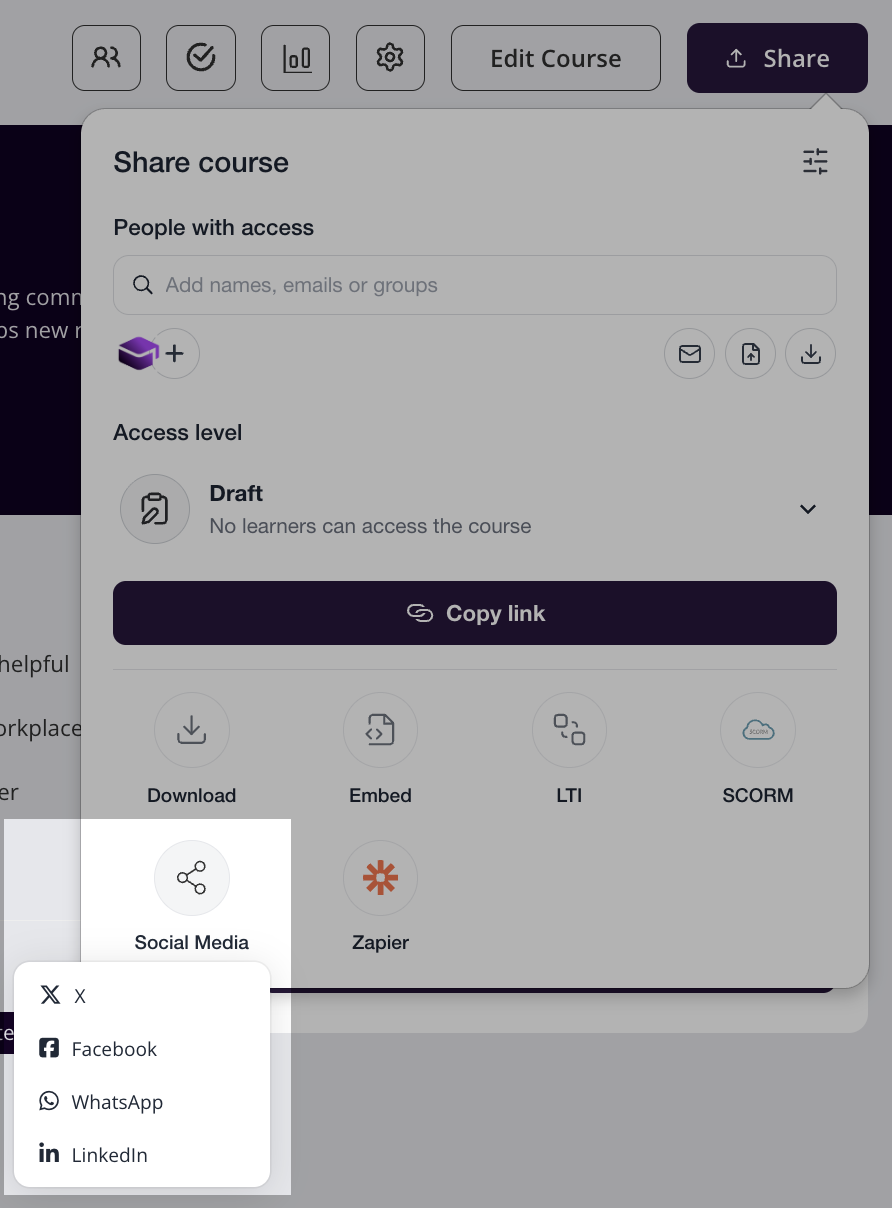
Click the platform you want to share to (e.g. Facebook, LinkedIn, Twitter/X).
A pre-populated post will open in a new tab — review and publish from there.
Tips for sharing
Make sure your course has a cover image set before sharing — this will appear as the preview image on social media.
Ensure your course is published and public before sharing the link.
Add a compelling course description to improve engagement when the link is shared.
Copy a course iFrame
Embedding your Coursebox course on other websites lets you share learning content seamlessly without asking learners to log into multiple platforms. Whether you're adding it to your company intranet, a WordPress site, or an LMS, the share feature gives you an iframe code that can be pasted anywhere HTML is supported. This makes it easy to showcase your course in the exact environment where your learners already engage.
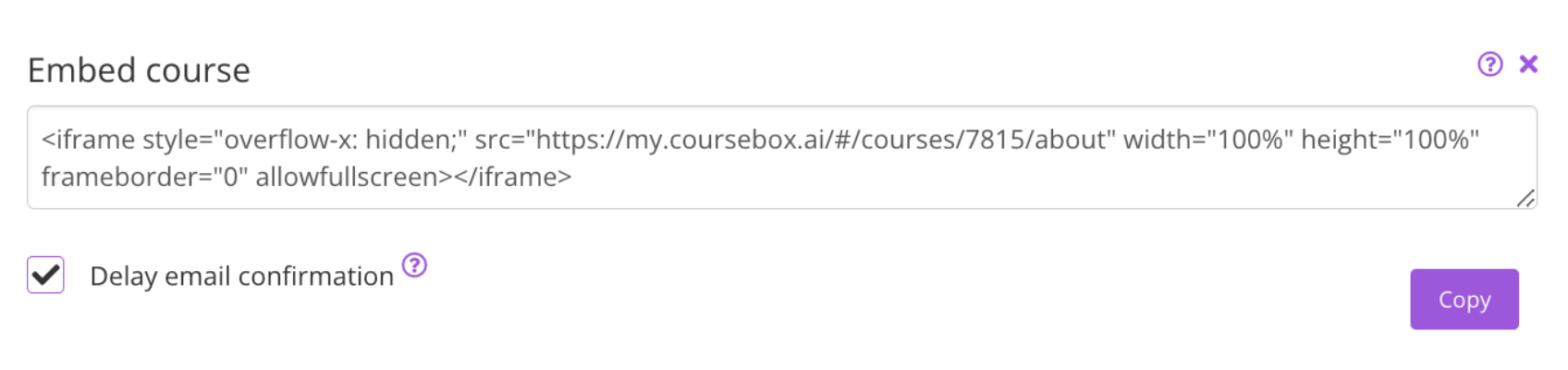
On any course, navigate to the course page and click the share icon > copy the iframe to copy the code.
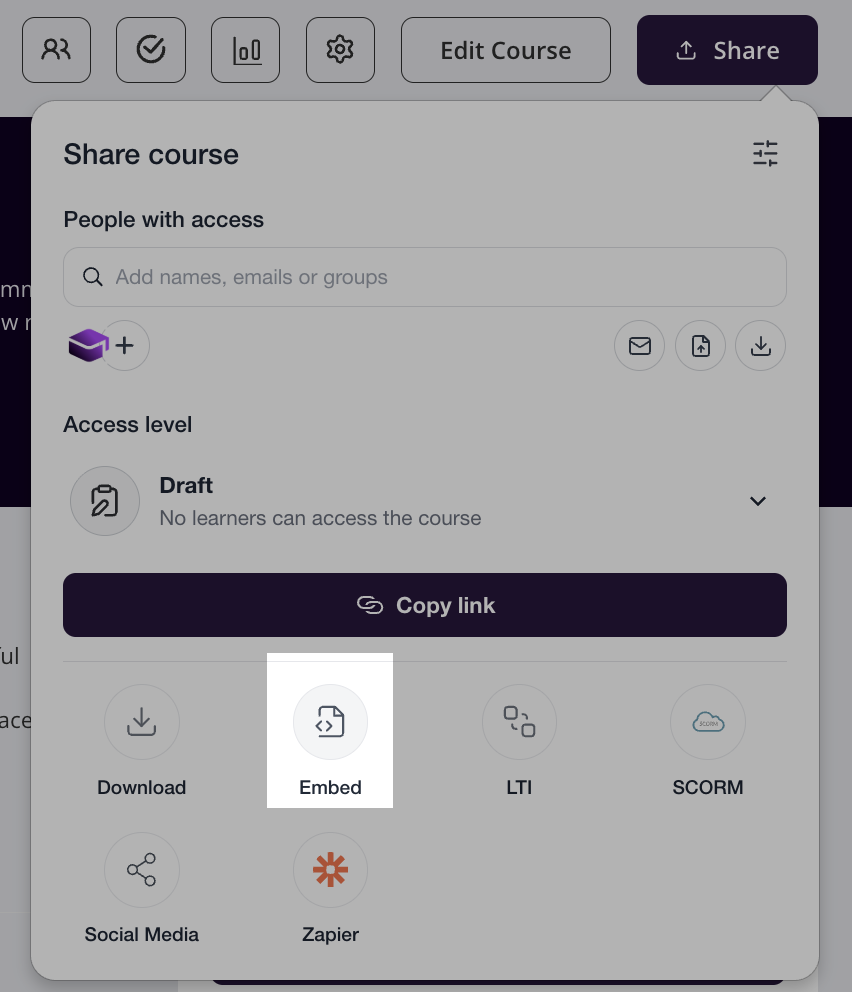
Then paste this using HTML anywhere on the web.
Share a course to an LMS with LTI 1.3
LTI requires Pro or above. Compare plans.
Coursebox acts as the Provider for LTI 1.3, which lets you add Coursebox courses into any LTI 1.3 compliant LMS. LTI creates a secure communication bridge between your LMS and Coursebox to launch the course and pass grades back.
The integration steps are straightforward:
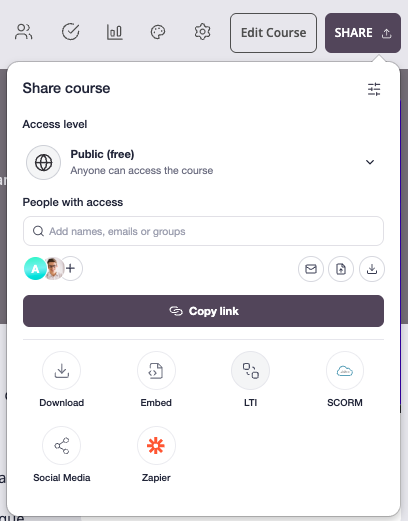
Open the Course in Coursebox, click on share button and click on LTI.
It will open a popup, where you can add your LMS. Click Add New LMS.
You will see the form with Coursebox LTI details. You will need to use these details to create an LTI Tool in your LMS.
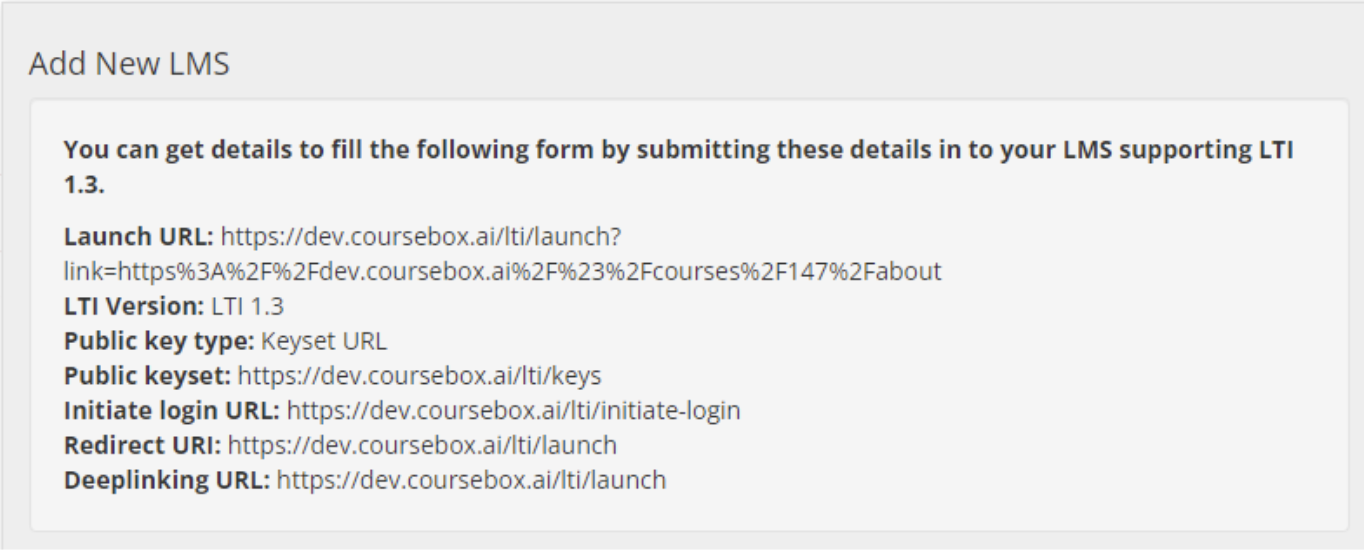
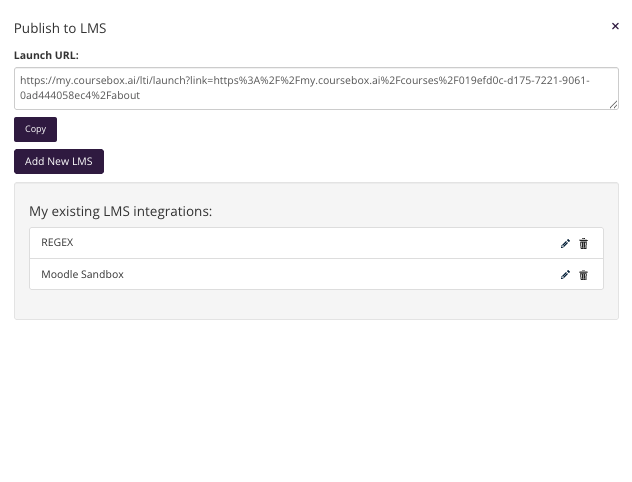
Once you enter the above details in your LMS, you will get details from your LMS to fill out the form in Coursebox. Field details are listed in the Field labelling chart below.
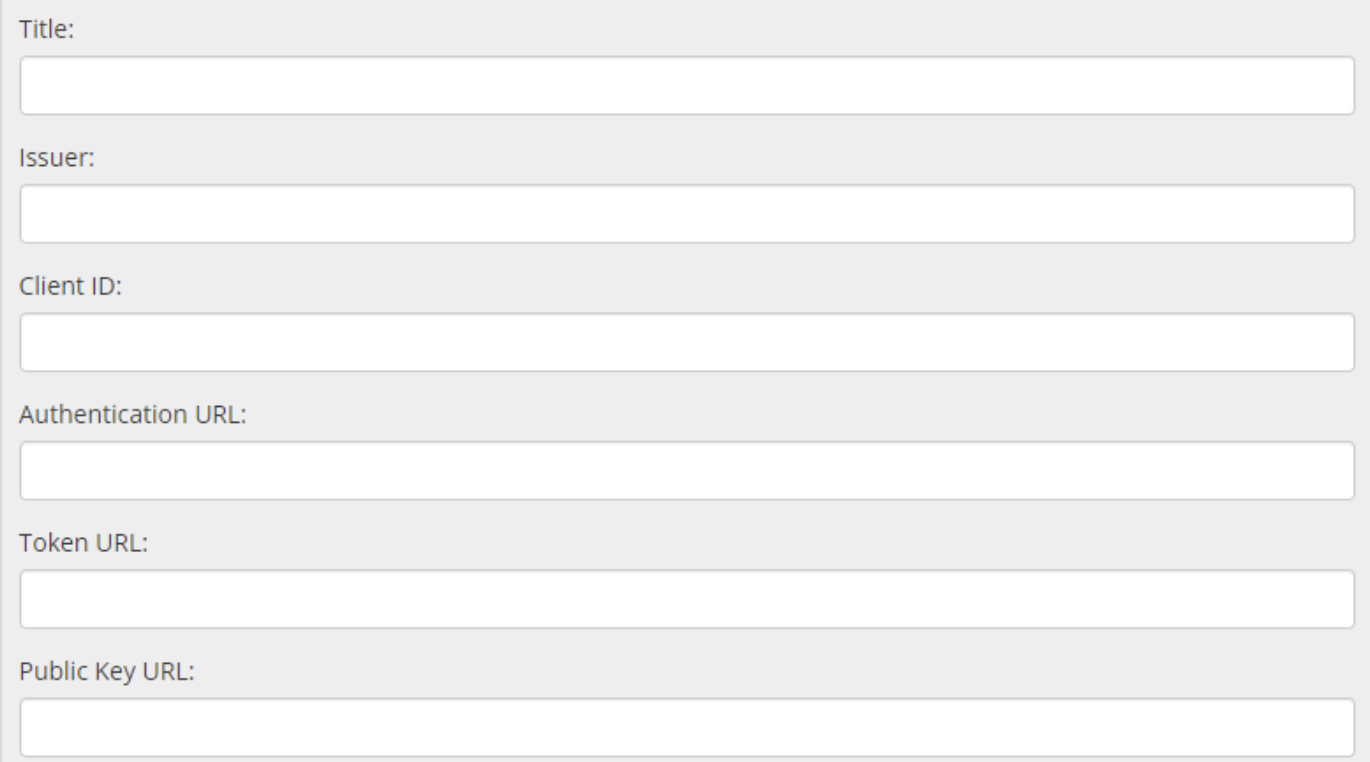
Now, you can start adding courses using the LTI Tool according to the guidelines provided in your LMS documentation.
Field labelling chart
Following is the chart for field labels to give an idea to handle the LTI Integration process.
Coursebox | Moodle | Schoolbox | Canvas |
|---|---|---|---|
Launch URL | Tool URL | Launch URL | Target Link URI |
LTI Version | LTI version | Version | N/A |
Public key type | Public key type | N/A | JWK Method |
Public keyset | Public keyset | JSON Web Key Set URL | Public JWK URL |
Initiate login URL | Initiate login URL | OpenID Connect Initiation URL | OpenID Connect Initiation URL |
Redirect URI | Redirection URI(s) | N/A | N/A |
Deeplinking URL | Content Selection URL | Deep Linking URL | Target Link URI under |
Issuer | Platform ID | Issuer | https://canvas.instructure.com |
Client ID | Client ID | Client/Deployment ID | Developer Key ID available in details |
Authentication URL | Authentication request URL | OpenID Connect Authentication URL | https://canvas.instructure.com/api/lti/authorize_redirect |
Token URL | Access token URL | oAuth Access Token URL | https://canvas.instructure.com/login/oauth2/token |
Public Key URL | Public keyset URL | JSON Web Key Set URL | https://canvas.instructure.com/api/lti/security/jwks |
Deep grading
Coursebox supports deep grading pass-back over LTI 1.3, sending more detailed grade information to your LMS gradebook beyond simple completion/score.
LTI needs an active subscription. LTI launches the live course from Coursebox, so courses embedded via LTI stop working if your subscription ends. If you need something that keeps working after cancellation, use Self-Hosted SCORM instead.
Export a course to SCORM 1.2 and 2004
Coursebox enables you to export courses in SCORM format, including 1.2 or 2004.
When you export a Coursebox course as SCORM, you're packaging your Coursebox pages, media, and completion logic into a standard zip that any SCORM-compliant LMS can play. The learning experience is still powered by Coursebox—the player, navigation, and tracking behaviours come from Coursebox's authoring and runtime—just delivered through your LMS.
Key things to know:
Edits after export: Most content edits — text, images, and quiz wording on existing pages — show up on the next launch in your LMS without a re-export. Re-export when the course structure changes (for example, adding or removing pages).
Branding: Your Coursebox styling and layout remain intact.
Tracking: Choose SCORM 1.2 (widely supported for completion/score) or SCORM 2004 (v3/v4) for advanced sequencing and bookmarking. Coursebox does not currently offer a separate setting to choose a specific SCORM 2004 sub-edition (e.g. 3rd vs 4th edition) — all SCORM 2004 exports use the same v3/v4 package format.
How Coursebox SCORM works (wrapper vs. standalone)
A Coursebox SCORM package is a wrapper, not a standalone bundle. The ZIP you download is intentionally small — often around 10 KB — because it contains pointers and a launcher, not the full course content. When a learner opens the package inside your LMS, the wrapper calls back to Coursebox to load the actual content, track progress, and (for SCORM 2004 / LTI 1.3) report grades.
This is why your course must stay published in Coursebox and your account must stay active for the wrapper to work.
What's inside the ZIP:
A SCORM-compliant manifest (
imsmanifest.xml)A small launcher (
index.htmland supporting files)Configuration pointing the launcher back to your published course on Coursebox
What's not inside the ZIP:
Course pages, images, videos, or audio
Quizzes or interactive blocks
Anything the learner sees in the course
That content stays on Coursebox and is served at runtime.
Why we built it this way:
Most content edits propagate instantly. Edits to existing pages — text, images, quiz wording — show up on the next launch in your LMS without a re-export. Re-export only when the course structure changes (for example, adding or removing pages).
Smaller upload to your LMS. LMSs with file-size limits stay happy.
Better tracking. Coursebox handles event capture and surfaces it back to the LMS through standard SCORM CMI calls.
If you need a package that keeps working after you unpublish the course or cancel your subscription, use Self-Hosted SCORM instead — see below.
Export to SCORM
In the Share panel, set the course visibility to published, then select the SCORM version (1.2 or 2004) required for upload to your LMS.
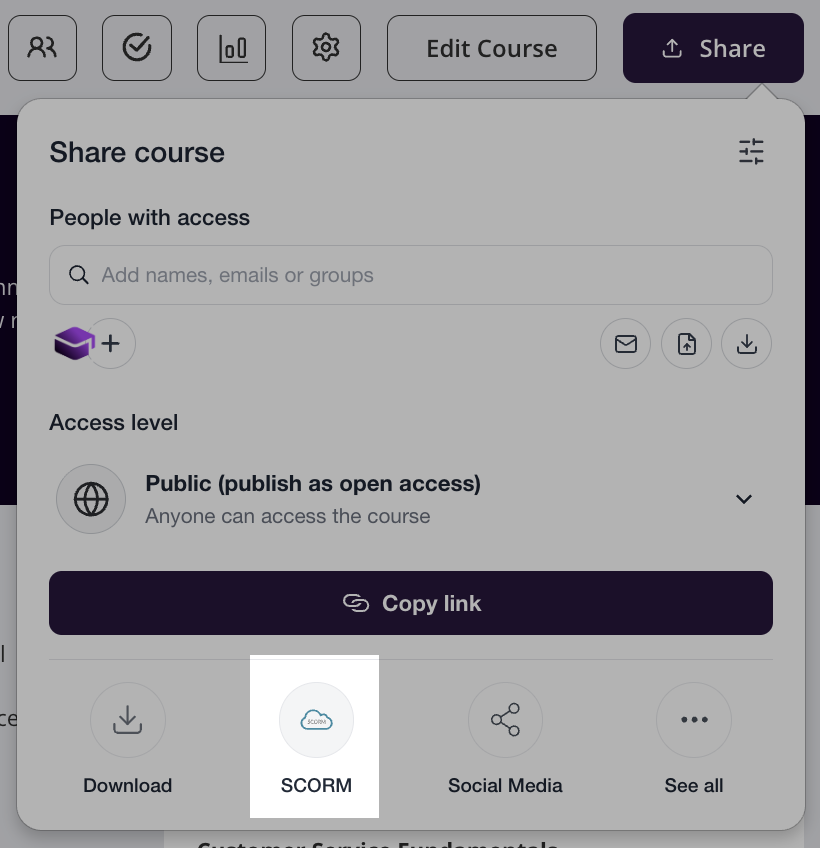
Note that this requires a published live sync to the course to take advantage of the AI and related live features.
Upload to your LMS
Each LMS has slightly different steps for uploading SCORM packages.
Always follow the official documentation for your platform to ensure compatibility. Below are links to SCORM guidelines for leading LMSs:
Moodle – SCORM activity – MoodleDocs
Blackboard Learn – Add a SCORM content package (Ultra)
Canvas – Import SCORM files as an assignment
aXcelerate – SCORM/xAPI E-Learning
D2L Brightspace – Import and Manage SCORM
TalentLMS – SCORM-Compliant LMS Features
SAP Litmos – SCORM-compliant courseware
Absorb LMS – SCORM/AICC/Tin-Can courses – Absorb Help
LearnDash – SCORM and xAPI Support
Schoology – Course Materials: SCORM Packages
Totara Learn – Add a SCORM activity
Open LMS – SCORM Content Creation Overview
Cornerstone OnDemand – Cornerstone SCORM support overview
iSpring Learn – Uploading SCORM to iSpring Learn
SCORM Cloud (testing) – Upload SCORM course to SCORM Cloud
Troubleshooting SCORM
"My SCORM ZIP is only ~10 KB — is it broken?"
No — that size is expected. The wrapper is small by design. The content lives on Coursebox.
"I can't see the export or SCORM options at all."
Check which plan you are on. Course export is not included on Free — the SCORM option is hidden and choosing a download shows an upgrade prompt. Creator and above includes Dynamic (Standard) SCORM; Self-Hosted SCORM requires Pro or above.
"The course shows a blank screen or 'content unavailable' inside my LMS."
Check, in order:
Is the course published in Coursebox? Open the course → Share → confirm visibility is set to Published.
Is your Coursebox account active (not paused, suspended, or past due)?
Did you upload the ZIP as a
.zip? Some LMSs require you not to unpack it first.Does your LMS allow the launcher to open
coursebox.aiin an iframe? Some LMSs block third-party iframes by default — check your LMS's iframe and mixed-content settings.
"HTML export works but SCORM doesn't load."
That's expected behaviour, not a bug. HTML export is a static one-time snapshot (no interactions, audio or video). SCORM is a live wrapper. Use HTML if you need static; use SCORM if you need progress tracking and live updates.
"I need progress and grades to flow back to my LMS."
Use SCORM 2004 (not SCORM 1.2) or LTI 1.3 if your LMS supports it. SCORM 1.2 reports completion only; SCORM 2004 reports completion plus interaction-level data; LTI 1.3 also supports grade passback to the LMS gradebook.
Export to self-hosted SCORM
Coursebox also supports exporting your course as a Self-Hosted SCORM package. This option generates a fully standalone package that can be hosted on your own server or LMS without requiring an active connection back to Coursebox. Because it does not call back to Coursebox, it keeps working offline, and after you unpublish the course or cancel your subscription.
Open your course in the Course Editor.
Click the Share button (top right) to open the Share panel.
Click the SCORM option to expand the SCORM export menu.
Select Export to Self-hosted SCORM.
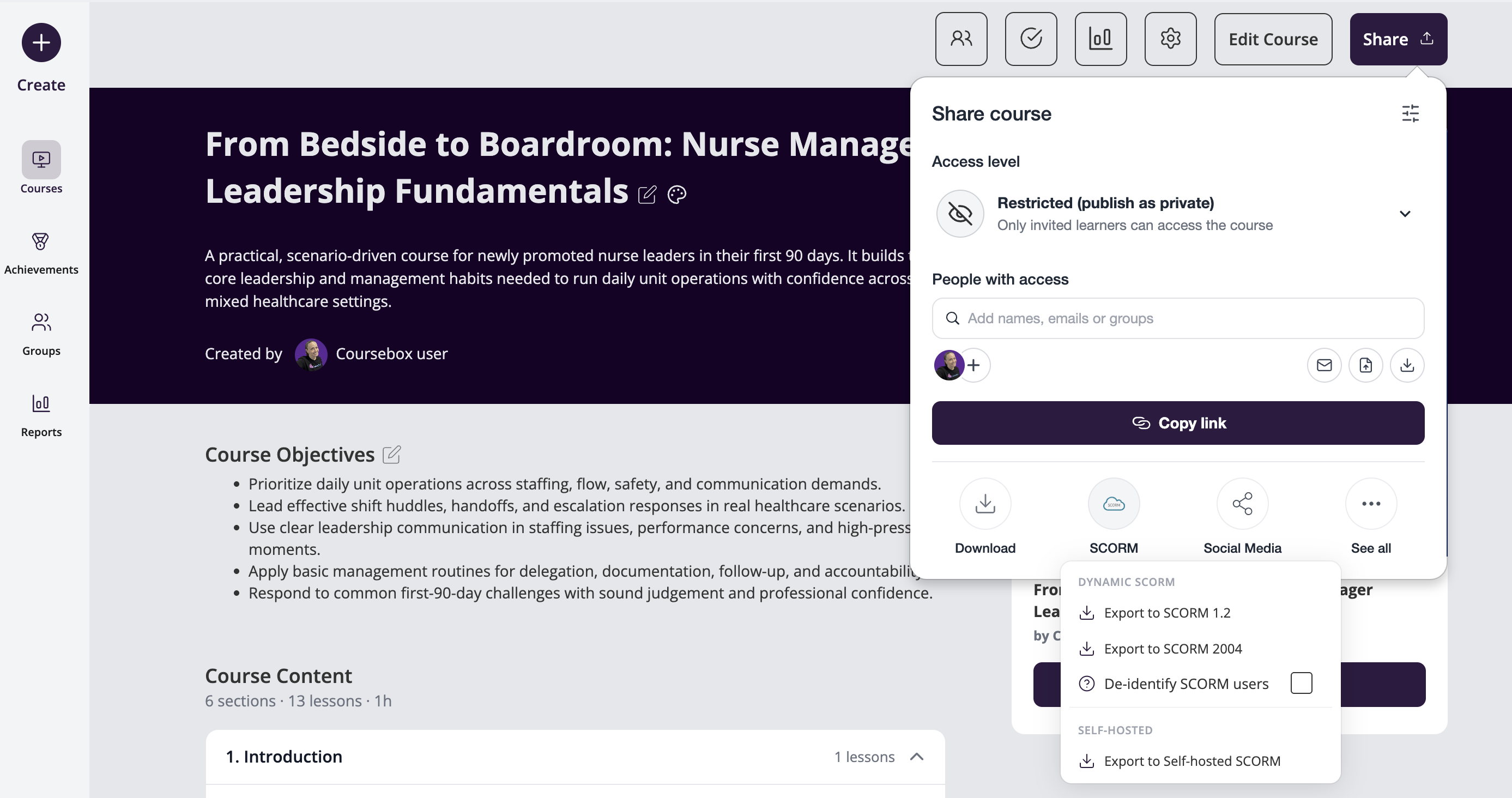
A Self-hosted SCORM Limitations dialog will appear. Review the limitations, then click Continue to proceed with the download.
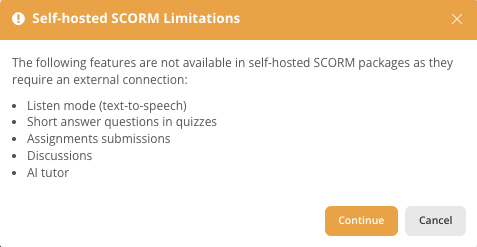
Self-hosted SCORM limitations
The following features are not available in self-hosted SCORM packages as they require an external connection:
Listen mode (text-to-speech)
Short answer questions in quizzes
Assignment submissions
Discussions
AI tutor
Uploaded SCORM content
A self-hosted package also does not update when you edit the course in Coursebox — re-export a fresh package to pick up changes.
Anonymous users via SCORM (where enabled)
Coursebox supports anonymous user access via SCORM when hosted in external LMS environments. This means learners can launch and interact with Coursebox courses embedded in SCORM packages without requiring a Coursebox login.
Use case examples:
SCORM-based compliance training with no user registration
One-click access via corporate LMS with limited tracking
Note: Anonymous SCORM users are available by default and can be enabled using the checkbox in the SCORM export tooltip.
Both anonymous and non-anonymous SCORM exports do not require learners to register in Coursebox.
The key difference is that with anonymous SCORM, no personal data (such as name, surname, or email address) is stored in Coursebox — only the student ID is recorded.
Standard SCORM vs. self-hosted SCORM: what happens if you pause or cancel
The table below contrasts what happens to Standard (Dynamic) SCORM exports versus Self-Hosted SCORM exports if your course is unpublished/cancelled or if you edit the course after exporting.
Scenario | Standard (Dynamic) SCORM | Self-Hosted SCORM |
|---|---|---|
Plan required | Creator and above | Pro and above |
Course unpublished | Stops working | Keeps working |
Account cancelled / inactive | Stops working | Keeps working |
Course content edited after export | Updates automatically on next launch (no re-export needed) | Does not update; a fresh package must be re-exported |
Planning to cancel? Export a Self-Hosted SCORM package before your subscription ends — it will keep working afterwards, while Standard (Dynamic) SCORM and LTI will not.
Important note on Standard (Dynamic) SCORM
This section applies to Standard (Dynamic) SCORM 1.2 and SCORM 2004 exports only. Self-Hosted SCORM is not affected — see the comparison table above.
Active account: your account must stay active. If it is not, the Standard SCORM integration will stop working.
Live and published courses: you cannot export to Standard SCORM from a course that is still in draft or unpublished status. The course must be published and live for the export to function correctly.
Do not unpublish the course: if you unpublish or delete your course after exporting it to Standard SCORM, the integration will stop working. The package will no longer be linked to the course, and updates or tracking will not be reflected.
Deploying multiple modules into an external LMS
Coursebox shares and exports at the course level, so how you structure your courses decides how they appear in your external LMS (for example Rippling). There are two common approaches:
Separate courses (one package each): Build each module as its own Coursebox course and export each one. Six modules become six courses and six SCORM packages, which appear in your LMS as six separate training items with their own completion tracking. Choose this when each module must be assigned, tracked, or reported on individually.
One course with multiple sections (single package): Build one Coursebox course containing all six modules as sections and export it once. This gives you one SCORM package that appears as a single training item in your LMS, with the modules as sections inside it. Choose this when you want learners to move through the modules as one program with a single completion.